
THREE CHALLENGES, TWO WEEKS, ONE TEAM

“You have the magic within you, now go change the world.” This quote was written for us in the program book of the HIA Fellowship. This phrase helped guide us throughout the process of the output phase of the fellowship. 

At the start of the output phase, we were presented with three challenges to choose from. After a great deal of brainstorming and several consultation meetings with HIA Poland, the organization we were working with, we chose to take up the technological challenge in order to best meet the needs of HIA Poland, who aimed to use technology to combat hate speech online among youth. Our main assumption was that if gamers use less hate speech online, they will also use less of it in the real world. 

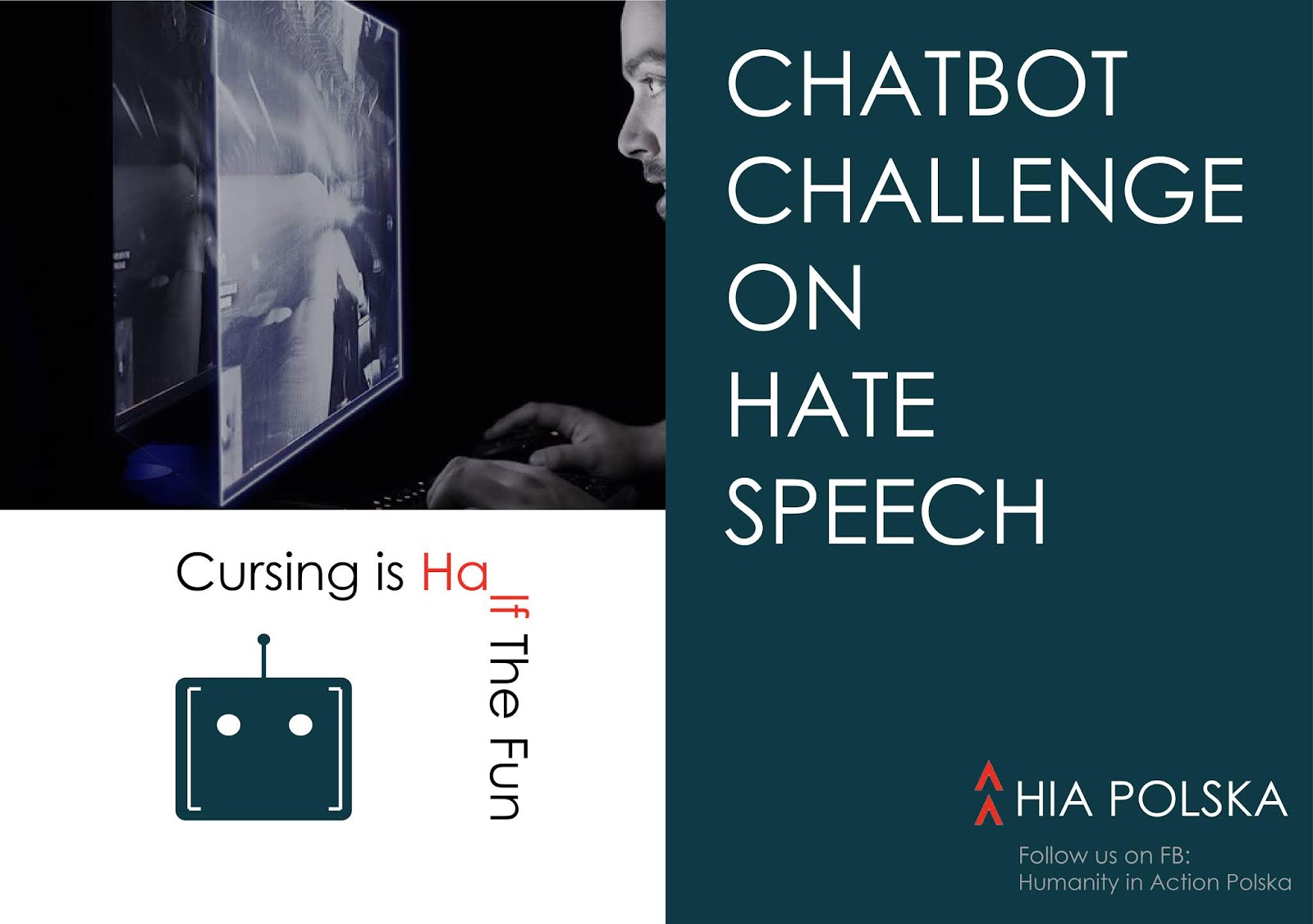
Working on the project was challenging, mostly because we were new to the field of chatbots, especially when it came to using chatbots toward a topic with as serious implications as hate speech. We first found challenges with improving the effectiveness of the chatbot and finding a way to make it more attractive to young users. We wanted our chatbot to be technologically advanced and to contain complex content that would adequately cater to our users. Using a 14-year-old male persona that we developed, we brainstormed how to best reduce the pains and increase the gains of individuals within our target group while raising their awareness of hate speech and its impact on others. After hours in the process of design thinking, we came up with the name “Cursing is Half the Fun” to attract young gamers, who we believed would be curious to discover the content behind the link. We created a visualisation of the chatbot content using a schema and sent it to some young individuals for a trial, also attaching a short follow-up questionnaire. 

Although we faced challenges along the way, our teamwork was always great and effective. No arguments, just discussions and brainstorming. No competition, always strong empowerment. It is safe to say that we all felt that we could not have imagined a better team. We combined different abilities, experiences, and passions to deliver the best solution we possibly could within the given time and resources. We gained new important skills and allowed ourselves to expand outside different communication styles/roles than a “buffalo” or an “eagle” (more explanation to that you can find here). We will look back on this experience with positivity and gratefulness, as it helped us grow and become more involved as activists and opened doors for us to pursue professional careers in whatever fields we choose. 


By May Lim, Rena Pitsaki and Ewa Rodzik, participants of the 2018 Humanity in Action Warsaw Fellowship

Comments

Popular posts from this blog

YOU CAN DO ANYTHING IF YOU HAVE ENTHUSIASM

From an early age, I have always liked to explore other cultures. Interesting history, art, music and language are topics that I have always loved getting introduced to. A couple years ago, I had a chance to learn about a culture that completely captivated me. My first encounter with the Jewish culture was during the Jewish Culture Festival „Singer’s Warsaw” when I had the opportunity to see the theater play „Violinist on the roof”, I tried Jewish Chałka and listened some Jewish piece of music.  Luckily this year, as part of the Humanity in Action Warsaw Fellowship Program, alongside other participants, I had the opportunity to explore Jewish culture more thoroughly.  The Jews were always present in the Polish society. Before the war, Poland was a country where three million Jews lived, and it was one of the largest congregations of Jews in the world. Jews constituted about 10% of the general population. Unfortunately, mainly due to the execution of the Holocaust, the...

#SEXISEQUAL - SO LET'S TALK ABOUT IT

Teenagers. They’re angsty, awkward, and sometimes angry, often for good reason. Teens are the chronically misunderstood, the frequently patronized, and the often ignored of our society. Their youthful ambition and adolescent, singular strength of mind will soon propel them (and, whether we like it or not, us too), into a future where they, at last, are the ones in charge. They represent the imminent future, and yet older people often do not know how to talk to teens—whether about their emotional lives, or merely what they want for supper.  Our group: Kamil Kuhr, Kenny Martin and Larysa Panasyk Photo Credit: Alicja Szulc These contradictions and difficulties of teenage life hit queer teenagers especially hard. In the input phase of the 2018 Warsaw Humanity in Action Fellowship, we had a session with Slava Melnyk from Kampania Przeciw Homofobii (Campaign Against Homophobia, Polish abbreviation KPH) that illuminated some of these problems—problems that are specific to the q...

Past and Present, Memory and Future: Preserving Invisible History by Chelsea Racelis

I was nine years old the first time I called any book my “favorite.” The book was Milkweed, a historical fiction novel set in Warsaw during the Holocaust and told through the lens of a young Jewish orphan, Misha. As the Nazi occupation progresses, Misha does not understand what is happening: Why is there a curfew? Why can’t his friend Janina and her family live in their house anymore? Why do he and his friends have to stay in the ghetto? Why is everyone being cleared out of the ghetto and put on trains? As I asked these questions alongside Misha, this book became my introduction to the Holocaust, and indeed to the notion of dehumanization. When I found out I was coming to Warsaw for the Humanity in Action Fellowship, it was as if everything had come full circle. I was told before I arrived that Warsaw had been bombed out in World War II, so its architecture was all built after the 1940s. Until we went on the (In)Visible History and Vibrant Present in the Streets of Warsaw walking ...